This post is an excerpt from Dr. Cheryl’s unpublished dissertation, Race and beauty in Canada: print culture, retail, and the transnational flow of products, images and ideologies, 1700s to present

Source: Upsplash
The first sentimental novels were brought to America in the eighteenth century from Britain. Initially, the genre was thought to corrupt and delude its readers with extravagant fancies, as a result, each preface asserted the “useful knowledge” and the “truthful” record of life that the novel provided.[1] Authors purported that the characters and also the settings were those of the realistic novel; according to Barbara Carolyn Quissell,
“the setting of the sentimental novel placed its characters in the midst of society – its drawing rooms, churches, markets and cottages. It was the house and its realm of manners and social groups that predominated.”[2]
The sentimental novelist conscientiously took on the role of moralist and because they also purported to be “truth tellers” this genre, more so than novels before it, captured the public’s imagination, especially with respect to social issues such as slavery, abolition, women, and social class.
Most prominently, in Harriet Beecher Stowe’s Uncle Tom’s Cabin (1852), characters crossed racial, class, and gendered boundaries in ways that captured in the public’s imagination. First published in the National Era as a weekly serial between June 1851 and April 1852, Harriet Beecher Stowe allegedly made up the story as she went along; a story which she and the editor had originally envisaged as running for 14 weekly instalments but within nine months of its publication a single volume form of the book became a hit.[3] Using sentimental and romantic devices, Stowe galvanized the abolitionist movement by encouraging her white readers to identify with the black characters in her book. Slaves were portrayed as “human beings” who suffered inhumane indignities and felt the same pain and anguish that whites would have felt.[4] In reality, when Uncle Tom’s Cabin appeared in 1852, Marcus Wood notes that “the treatment of Africans and African-Americans within Western cultural forms had significantly shifted over the preceding twenty years. Scientific racism had substantially developed and had infiltrated art and literature.”[5] As such, while the sentimental novel galvanized the abolitionist cause, it did not refute widely held beliefs about the supposed inferiority of blacks. Scientific racism had played a pivotal role in entrenching such beliefs.
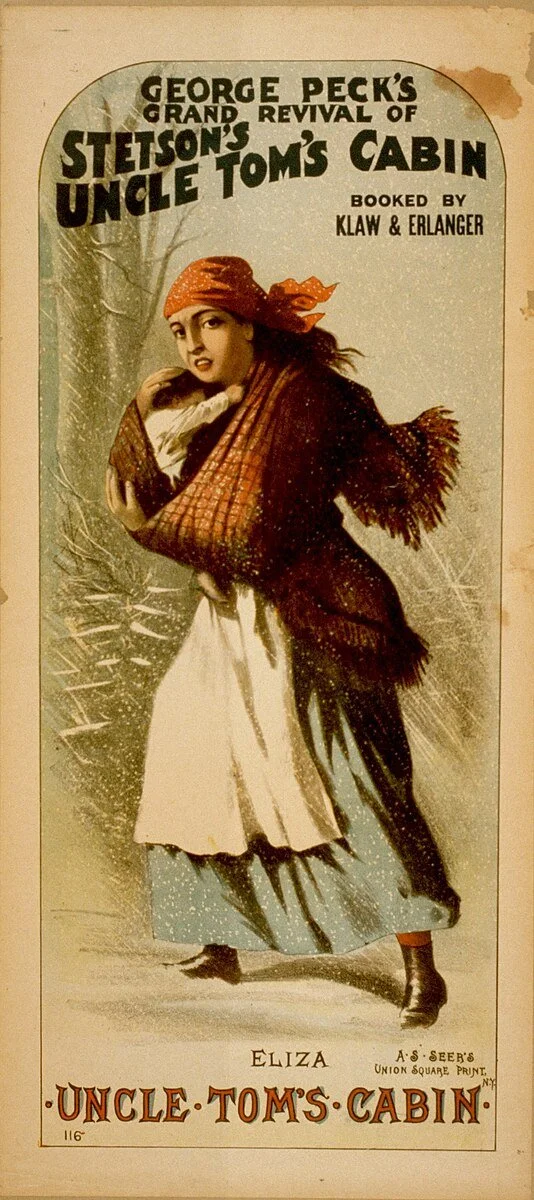
Source: Wikimedia Commons
1886 poster for "George Peck's grand revival of Stetson's Uncle Tom's cabin, booked by Klaw & Erlanger." (Stage play based on Uncle Tom's Cabin)
In the early nineteenth century, biological racialists, including phrenologists, craniologists, physiognomists, anthropometrists, ethnologists, polygenesists and Egyptologists, worked to establish innate biological differences between whites and blacks.[6] Contrary to the eighteenth-century race theorists who preceded them, and who generally attributed racial distinctions to environmental conditions, this new breed of scientists were particularly eager to not only establish differences between the races but also to “prove” the moral and intellectual superiority of the Anglo-Saxon race.[7] Nineteenth-century scientists even went so far as to disseminate theories to prove that “the Negro’s head was covered with wool rather than hair.”[8]
Even African American abolitionist Frederick Douglass, in considering the “ethnological unfairness towards the Negro,” remarked upon how leading ethnologists had developed elaborate arguments to prove the Egyptian was distinct from Africans even though they were as dark as the Africans and “their hair was far from being of that graceful lankness which adorns the Anglo-Saxon head.”[9]
Significantly, British scientists Francis Galton, cousin of Charles Darwin[10] often proclaimed that Anglo-Saxons represented “a modern racial pinnacle to which those of African descent would never rise.”[11] As Kathy Peiss points out, nineteenth-century travelers and missionaries also viewed beauty as a function of race, “and because appearance and character were considered to be commensurate, the beauty of white skin expressed Anglo-Saxon virtue and civilization – and justified white supremacy in a period of American expansion.”[12]
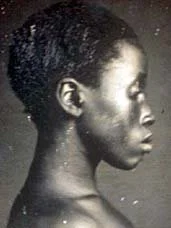
Source: Wikimedia Commons
Daguerreotype of Delia, a slave woman on a plantation in Columbia, South Carolina. Delia was an American born slave, daughter of Congo born slave "Renty". One of a series of photo-portraits of slaves made for Louis Agassiz in 1850 for his study of races.
In the 1850s, Dr. Robert W. Gibbes, a nationally recognized palaeontologist, hired local daguerreotypist Joseph T. Zealy to make photographic records of first-and second-generation slaves on plantations near Columbia, South Carolina for Swiss-born Louis Agassiz, the natural scientist and zoologist from Harvard University.[13] Using the frontal/profile combination that was first used in ethnographic photography, Zealy documented slave women and men in half-and full-length views stripped to the waist or, in the case of some of the men, totally naked.[14] The result was a denial of black women’s (and men’s) humanity and also control over the representation of their bodies, removing all agency and power from their naked bodies.[15] The visual “evidence” of scientists coupled with the rhetoric of the sentimental novel made the black female body a site of supposed deviancy but simultaneously also a site of white pity.
In 1854, for example, when English botanist, writer and artist Amelia Matilda Murray visited Quebec and Ontario, on her first trip to Quebec City she noted, “Canadian ladies” are more like the French “in their enjoyment of passing moments, and are generally pretty natural, and well dressed, so that I have found their acquaintances agreeable.”[16] On a visit to the Niagara Region, on the other hand, in a letter dated 28 October 1854, she lamented, “One of the evils consequent upon Southern slavery is the ignorant and miserable set of coloured people who throw themselves in Canada.”[17] As Wood asserts, the evangelical sentiments in Uncle Tom’s Cabin had been
“music to English ears, articulating the entire rationale for missionary, political and economic colonisation of Africa – namely the enlightenment of the black heathen by the Christian Saxon.”[18]
Stowe’s creation of primarily mulatto and quadroon slave children (with strong Christian values) whose skin colour differed little from that of whites appeased many British abolitionists. As Murray writes further,
black and mulatto children were playing about near some small log houses, close to a marsh, on its shore; one clean-looking intelligent girl, about seven helped to look for shells, and then asked me to visit her mother who, she said, was sick in a hut close by. I followed the child, and found her mother in bed, quite alone, with the exception of a tiny black babe, only two hours old, by her side…. Everything around this woman spoke of tidy and cleanly habits; a little Bible well bound and was on the table close to her bed, and other comforts evinced education and order beyond the usual negro habits.[19]
The association between the intelligence and cleanliness of black children was also perpetuated in Victorian era commodity advertising.
Anne McClintock has argued that one of the consequences of centuries of colonial domination was that whiteness functioned as both a form of spectacle and desire in capitalist production. The manufacture of soap had burgeoned into an imperial commerce at the beginning of the nineteenth century, and as a consequence,
“Victorian cleaning rituals were peddled globally as the God-given sign of Britain’s evolutionary superiority, and soap was invested with magical, fetish powers.”[20]
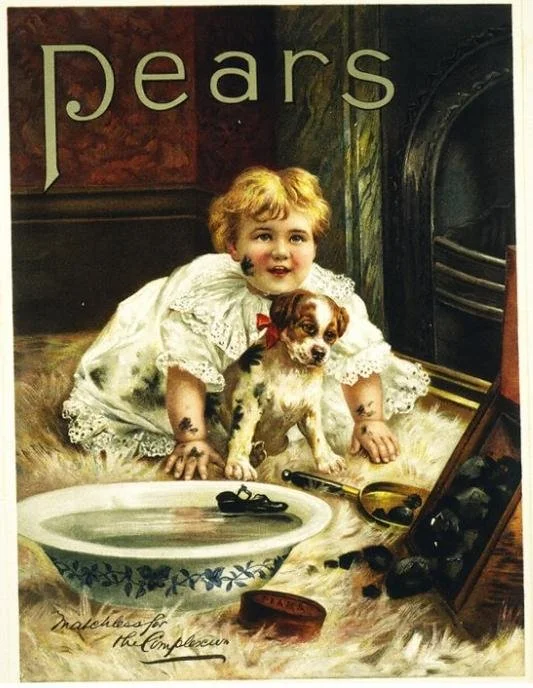
Source: Wikimedia Commons
Poster for Pears soap, 1900, A. & F. Pears Ltd. V&A Museum no. E.1064-1919
The cult of domesticity positioned white women’s bodies within the domestic space, but the imperialist production of soap advertising equated monogamy (“clean” sex) with industrial capital (“clean” money), Christianity (“being washed clean”), and class control (“washing and clothing the savage”).[21] Soap companies even went so far as to use caricatures of black children to sell whiteness as “clean” and conversely, blackness as “degenerate.”
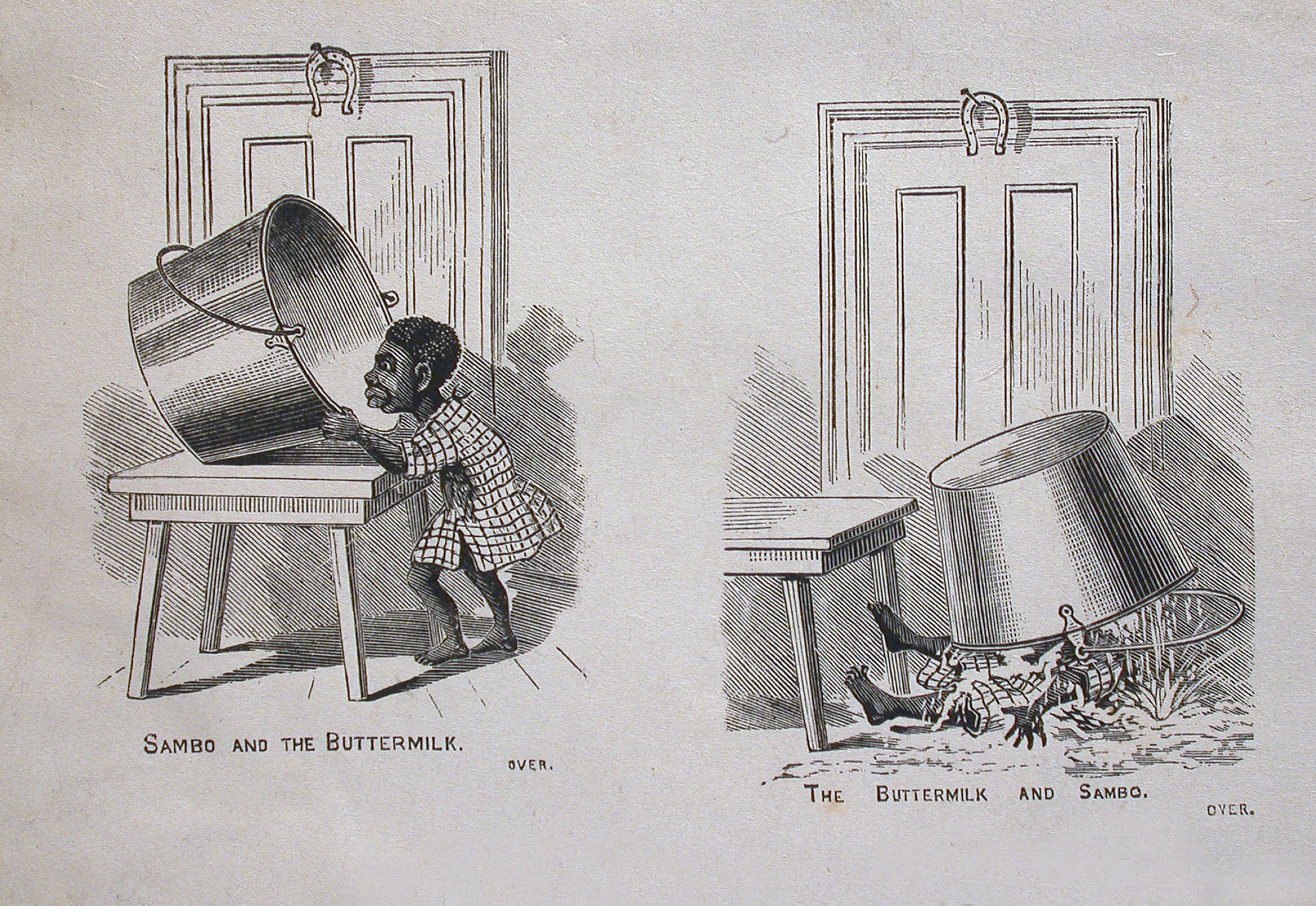
Source: McCord Museum
John Henry Walker, Sambo and the Buttermilk, ca. 1850-1885.
In 1844, for instance, the N.K. Fairbanks Company introduced the cartoon images of two black children, the Gold Dust Twins (Goldy and Dusty), to promote its brand of soap (fig. 1.3). Meanwhile in Canada an advertising print produced by John Henry Walker (1831-1899) which depicted the stereotype of Sambo covered in buttermilk, a symbolic representation of a black child subsumed in whiteness, circulated between the 1850s and 1880s.[22]
As Thomas Hine aptly notes,
“these racist images … that reflected ethnic stereotypes, provided products with personalities that were apparently unthreatening. They were a kind of servant just about anyone could afford, with the frequent exception of people who belonged to the groups shown on the package.”[23]
The connection between empire and cleanliness was also promoted in hair care. By the 1870s, Britain began exporting shampoo to Europe and soon thereafter, the colonies.[24] Thus, while Harriet Beecher Stowe’s novel was the first mass produced and widely distributed book to become a form of popular culture on both sides of the Atlantic, its success coincided with the popularity of scientific and commodity racism.[25]
Stowe first emphasizes the dress of her light-skinned slaves in order to evoke the sympathies of white middle-class Americans.[26] The character of Cassy, for instance, despite her racial status, is positioned to evoke empathy because of her light skin and garments that embodied white, middle-class values while other sympathetic characters – the slave mother and daughter, Susan and Emmeline – are also dressed in representative middle-class attire.[27] When Susan and Emmeline are introduced in “The Slave Warehouse,” their bodies, which are in close approximation to the white body, are described as follows:
One of these is a respectably-dressed mulatto woman between forty and fifty, with soft eyes and a gentle and pleasing physiognomy. She has on her head a high-raised turban, made of a gay red Madras handkerchief…. By her side, and nestling closely to her, is a young girl of fifteen, - her daughter. She is a quadroon, as may be seen from her fairer complexion…. She has the same soft, dark eye, with longer lashes, and her curling hair is of a luxuriant brown. She also is dressed with great neatness, and her white, delicate hands betray very little acquaintance with servile toil.[28]
Eve Allegra Raimon asserts that the “literary mulatto” emerged as a favourite theme of antislavery, sentimental fiction because these light-skinned characters could be appropriated and exploited to “suit the sentimental conventions and readerly expectations of the day. In both lived experience and in fiction … the mixed-race body was perpetually refigured, regulated, and neutralized all at once.”[29] Similarly, in nineteenth-century Spanish-Caribbean literature and cultural production Alicia Arrizón notes that
“the mulatta body [was] defined and constituted as an extension of oppressive colonial practices, a perspective that helped locate the embodiment of sexuality linked to this colonial order.”[30]
…
By the 1850s, black women were firmly positioned in an antithetical opposition to white women.[38] The public exhibition of Saartjie Baartman, Sarah Bartmann, Saat-Jee, or the “Hottentot Venus,” also played a pivotal role in the positioning of black women.[39] When Saartjie Baartman, a South African Khoi or San woman of “mixed blood,” was exhibited as a curiosity in Europe, first in London and then Paris, from 1820 to 1815, she became an emblem of European fascination with the body and sexuality of black women.[40] In comparison to the Sable Venus that preceded her, Willis and Williams assert that Baartman was
“given a sobriquet linking her to a Western icon of physical pulchritude and sexual desirability. Yet by European standards Venus, the Roman goddess of love and beauty, differed from Baartman as day from night.”[41]
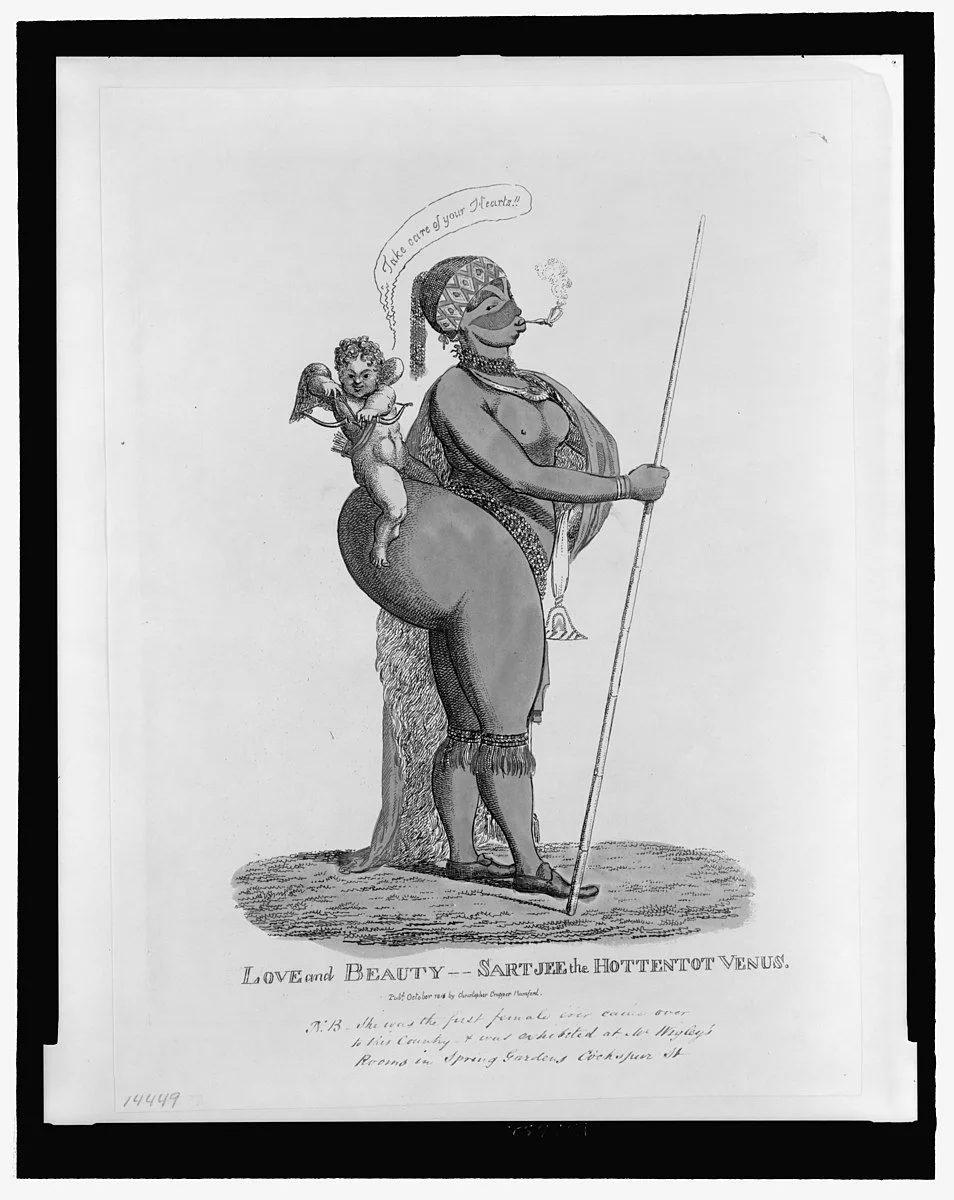
Source: Wikimedia Commons
British Cartoon Print Collection, Love and beauty--Sartjee the Hottentot Venus, c. 1811
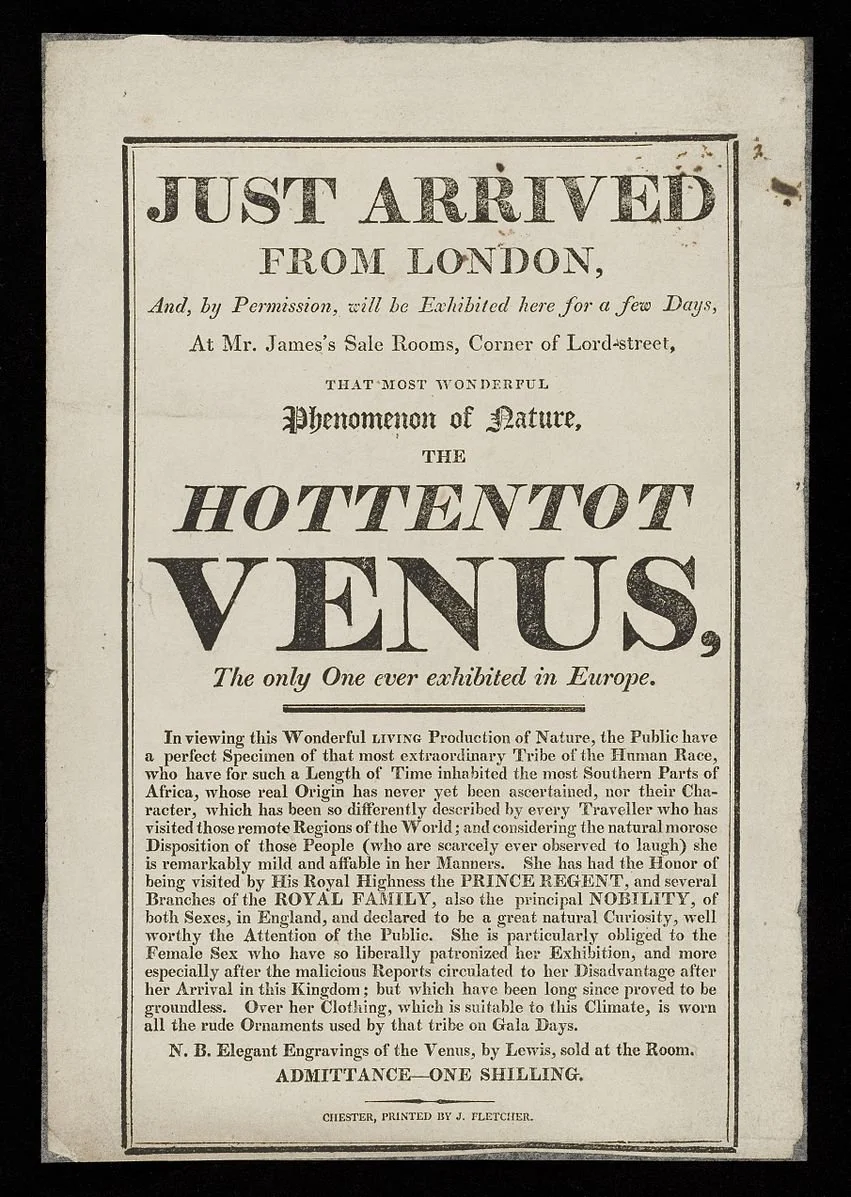
Source: Wikimedia Commons
Small poster advertising the exhibition of the “Hottentot Venus,” Saartjie Baartman (1789-1815)
The “Hottentot Venus” was a colonial stereotype which attempted to homogenize representations of black female sexuality as “primitive” and pathological.[43] Since European concepts of feminine beauty were bound up with notions of purity, delicacy, modesty and physical fragility, black women were viewed as physically strong, exuding an “animal sensuality,” which for many scientists was evidence of their inferiority and lack of beauty.[44] An 1822 etching of Baartman produced by British engraver Charles Williams, for example, captures her nude, smoking a pipe, with the figure of cupid sitting on her buttocks. The print illustrates how visual and scientific discourses in nineteenth-century Britain saw the buttocks of the Hottentot as a “sign of the primitive, grotesque nature of the black female,”[45] but paradoxically, also an object of white men’s sexual desires.
Saartjie Baartman occupies a special position in the genealogy of a race/gender visual, as an arbitrary starting point, which precedes photography because she was essentially the first black woman to be documented and have her image widely circulated through drawings, watercolors, and writings, in addition to the preservation of her private organs.[42]
The nineteenth century was ultimately a period filled with contradictions. While the domestic sphere increasingly became a site of agency in terms of white women’s ability to consume, it simultaneously remained a site of patriarchal oppression.[46] Behind an image of white middle-class gentility, the domestic interior also masked slavery’s exploitation of black women. With advancements in photography in the latter part of the century, black women acquired the means to self-represent, and an ability to create counter images which challenged scientists, the image of blackness in the sentimental novel, and commodity advertising. At the same time, social movements and transformations in women’s dress in the latter part of the nineteenth century ushered in a new ideology of womanhood that shifted the parameters of beauty, and the public visibility of both white and black women.
notes
[1] Barbara Carolyn Quissell, “The Sentimental and Utopian Novels of Nineteenth Century America: Romance and Social Issues” (PhD. Diss., University of Utah, 1973), 19.
[2] Quissell, “Sentimental and Utopian Novels,” 22.
[3] Marcus Wood, “Beyond the Cover: Uncle Tom’s Cabin and Slavery as Global Entertainment,” Blind Memory: Visual Representations of Slavery in England and America, 1780-1865 (Manchester: Manchester University Press, 2000), 145. Stowe based her novel on the life of Josiah Henson, an escaped slave whose biography overlapped with that of Uncle Tom, and he also corresponded with Stowe during the composition of Uncle Tom’s Cabin. Henson appeared in several English publications in 1853 and became a celebrity in his own right. Eventually he returned to Canada, residing in Dresden, Ontario. See Wood, “Beyond the Cover,” 195-98. There is a tourist site to Henson in Dresden called “Uncle Tom's Cabin Historic Site,” see Heritage Trust, http://www.heritagetrust.on.ca/Uncle-Tom-s-Cabin-Historic-Site/Home.aspx (date of last access 29 September 2013).
[4] Robert C. Toll, Blacking Up: The Minstrel Show in Nineteenth-Century America (New York: Oxford University Press, 1974), 88-9.
[5] Wood, “Beyond the Cover,” 143.
[6] Smith, American Archives: Gender, Race, and Class in Visual Culture (Princeton, New Jersey: Princeton University Press, 1999), 30.
[7] Smith, American Archives, 30.
[8] Arthur Riss, Race, Slavery, and Liberalism in Nineteenth-Century American Literature (New York: Cambridge University Press, 2006), 98. Peter A. Browne was the period’s foremost expert on trichology (the study of hair). In a paper Browne presented to the American Association for the Advancement of Science in March 1850 (about one year before Stowe began to serialize Uncle Tom’s Cabin in the National Era), Browne argued that the relationship between hair and race is more stable than the relation between colour and race. Browne opposed his scientific work to the work of the British ethnologist James Cowles Prichard, the foremost champion of monogenesis, the theory that there was one origin for all human kinds and that racial difference developed over time. According to Prichard “the Negro is covered not with wool, but with hair that differs from the European’s only in the ‘degree of crispation.’” See Riss, Race, Slavery, and Liberalism, 99.
[9] Frederick Douglass, “The Claims of the Negro Ethnologically Considered: An Address Delivered in Hudson, Ohio, on 12 July 1854,” in The Frederick Douglass Papers Ser. I, Vol. 2, Speeches, Debate, and Interviews, 1847-1854, John Blassingame et al., eds. (New Haven: Yale University Press, 1982), 508; also see Riss, Race, Slavery, and Liberalism, 103.
[10] Darwin’s On the Origin of Species (1859) and The Descent of Man (1871) had triggered a general interest in the documentation of the “other” in the scientific fields of anthropology, ethnography and ethnology.
[11] Smith, Photography on the Color Line, 52.
[12] Peiss, Hope in a Jar, 31.
[13] Carla Williams, “Naked, Neutered, or Noble: The Black Female Body in America and the Problem of Photographic History,” in Skin Deep, Spirit Strong: The Black Female Body in American Culture, ed. Kimberly Wallace-Sanders (Ann Arbor, Michigan: The University of Michigan Press, 2002), 185.
[14] Willis and Williams, Black Female Body, 22.
[15] Willis and Williams, Black Female Body, 23.
[16] Amelia M. Murray, Letters from the United States, Cuba and Canada (New York: G.P. Putnam & Company, 1856), 83. Other travel accounts of Canada in the nineteenth century provide a quantitative dictation on the black population of Canada West, see Benjamin Drew, A North-Side View of Slavery, The Refugee or the Narratives of Fugitive Slaves in Canada (Boston: John P. Jewett and Company, 1856) or missionary accounts detailing differences between Americans and Canadians, see James Dixon, Personal Narrative of a Tour Through a Part of the United States and Canada (New York: Lane & Scott, 1849).
[17] Murray, Letters from the United States, 118.
[18] Wood, “Beyond the Cover,” 194.
[19] Murray, Letters from the United States, 119-20.
[20] Anne McClintock, “Soft-Soaping Empire: Commodity Racism and Imperial Advertising,” in Imperial Leather: Race, Gender and Sexuality in the Colonial Conquest (New York: Routledge, 1995), 207.
[21] McClintock, “Soft-Soaping Empire,” 208.
[22] See John Henry Walker, Sambo and the Buttermilk, ca. 1850-1885. Wood engraving, ink on paper on supporting paper, 9.5 x 14.1 cm. Paintings, Prints and Drawings, McCord Museum of Canadian History, Montreal, Quebec.
[23] Thomas Hine, The Total Package: The Evolution and Secret Meanings of Boxes, Bottles, Cans, and Tubes (Boston: Little, Brown and Company, 1995), 91-2.
[24] Rifelj, Coiffures, 157.
[25] As an example of how Uncle Tom’s Cabin resonated with the British, when Amelia Murray visits Charleston, South Carolina in January 1855, she writes: “Mrs. Stowe’s Topsy is a perfect illustration of Darkie’s character, and many of the sad histories of which her book is made up may be true as isolated facts; but yet I feel sure that, as a whole, the story, however ingeniously worked up, is an unfair picture; a libel upon the slaveholder as a body. I very much doubt if a real Uncle Tom can be found in the whole Negro race; and if such a being is, or was, he is a great rarity as a Shakespeare among whites.” Murray, Letters from the United States, 198. Sarah Meer observes that the novel was transformed into songs, plays, sketches, and its imagery was soon transferred to paintings, puzzles, cards, board games, plates, spoons, china figurines, bronze ornaments, dolls, and wallpaper. See Meer, Uncle Tom Mania: Slavery, Minstrelsy & Transatlantic Culture in the 1850s (Athens, Georgia: University of Georgia Press, 2005), 1-2.
[26] Mattingly, Appropriate[ing] Dress, 86.
[27] Mattingly, Appropriate[ing] Dress, 86.
[28] Harriet Beecher Stowe, “The Slave Warehouse” in Uncle Tom’s Cabin of, Life Among the Lowly, ed. Ann Douglas (New York: Penguin Books, [1851] 1981), 471. In some parts of the South mulattos were bred and sold for huge profit on the female slave market. “Pretty quadroons” and “exotic octoroons” were in particularly high demand, and light-skinned women were sometimes called “fancy girls,” and were auctioned at “quadroon balls” held regularly in New Orleans and Charleston. See Kathy Russell, Midge Wilson and Ronald Hall, The Color Complex: The Politics of Skin Color Among African Americans (New York: Anchor Books, 1992), 18.
[29] Eve Allegra Raimon, The “Tragic Mulatta” Revisted: Race and Nationalism in Nineteenth-Century Antislavery Fiction (New Brunswick, New Jersey: Rutgers University Press, 2004), 93.
[30] Alicia Arrizón, Queering Mestizaje: Transculturation and Performance (Ann Arbor: The University of Michigan Press, 2006), 101. She writes further that “sexual encounters between the races and consequent mixed-raced offspring were accepted only if these relations were between white men and dark-skinned women, but not between dark-skinned men and white women (particularly the upper class).” See Arrizón, Queering Mestizaje, 103.
[31] See Jennifer DeVere Brody, Impossible Purities: Blackness, Femininity, and Victorian Culture (Durham and London: Duke University Press, 1998), 81. It is beyond the scope of this chapter to provide a detailed discussion of the history of blackface minstrelsy in North America and Britain; for more on its rise and popularity as a form of popular culture see Michael Pickering, Blackface Minstrelsy in Britain (Hampshire, England: Ashgate Publishing, 2008); Eric Lott, Love and Theft: Blackface Minstrelsy and the American Working Class (New York and Oxford: Oxford University Press, 1993); Alexander Saxton, “Blackface Minstrelsy,” The Rise and Fall of The White Republic: Class Politics and Mass Culture in Nineteenth-Century America (London and New York: Verso, 1990), 165-182; David R. Roediger, The Wages of Whiteness: Race and the Making of the American Working Class (London and New York: Verso, 2007).
[32] Stephen Johnson, “Uncle Tom and the Minstrels: Seeing Black and White Stage in Canada West prior to the American Civil War” in (Post)Colonial Stages: Critical & Creative Views on Drama, Theatre & Performance, ed. Helen Gilbert (London: Villiers Publishing, 1999), 56-7. Shortly after it appeared as a serial in 1851 in The National Era, two panoramas of Uncle Tom’s Cabin were presented at Toronto’s St. Lawrence Hall, and then there were hundreds of performances in the city at the Toronto Lyceum in May and June 1853. See Frost, I’ve Got A Home in Glory Land, 283.
[33] Both Eliza and George cross racial and class boundaries by transgressing gender roles in their escape. As Eliza and George make their final escape into Canada, Eliza changes her identity to that of a man by “trimming her long hair, donning masculine clothing, and adopting a different manner of putting on her cloak. Her son, Harry, likewise becomes Harriet with a simple change of clothing.” See Mattingly, Appropriate[ing] Dress, 86.
[34] Stowe, “Topsy,” 351.
[35] Stowe, “Evangeline,” 230.
[36] Robin Bernstein, Racial Innocence: Performing American Childhood from Slavery to Civil Rights (New York: New York University Press, 2011), 15.
[37] Riss, Race, Slavery, and Liberalism, 97.
[38] Sander Gilman, “Black Bodies, White Bodies: Toward an Iconography of Female Sexuality in Late Nineteenth-Century Art, Medicine, and literature” Critical Inquiry 12 (Autumn 1985): 212.
[39] A recent collection, Black Venus 2010: They Called her “Hottentot”, ed. Deborah Willis (Philadelphia: Temple University Press, 2010) provides a thorough account of Saartjie Baartman’s life.
[40] The term “Hottentot” had been dubbed by Dutch settlers of South Africa. See Willis and Williams, Black Female Body, 59.
[41] Willis and Williams, Black Female Body, 59-60. The Sable Venus’s nudity and black skin, as Kriz writes, “are signs of her [supposed] savagery and fitness to be enslaved. Likewise, the fullness of her thighs and limbs suggests her fitness for labor, her sexuality, and her ability to reproduce.” See Kriz, Slavery, Sugar, and the Culture of Refinement, 96.
[42] Michele Wallace, “The Imperial Gaze: Venus Hottentot, Human Display, and World’s Fairs,” in Black Venus 2010: They Called Her “Hottentot”, ed. Deborah Willis (Philadelphia: Temple University Press, 2010), 150.
[43] Charmaine Nelson, “The ‘Hottentot Venus’ in Canada: Modernism, Censorship and the Racial Limits of Female sexuality,” in Black Venus 2010: They Called her “Hottentot”, ed. Deborah Willis (Philadelphia: Temple University Press, 2010), 114. After her death in Paris in 1815, Baartman’s body was moved to a laboratory for further investigation and dissection and then to a museum shelf at the Musée de l’Homme in Paris, where her genitals were stored in a jar and displayed. Her body had been dissected after her death, her bones boiled, and her brain and genitals bottled. Cuvier, the father of both comparative anatomy and palaeontology, conducted the post-mortem examination and plaster casts were taken of her body. For nearly two centuries Baartman’s body parts were kept in on public display. In large part due to the efforts of South African political groups, Baartman’s body was repatriated back to South Africa. On 9 August 2002, to coincide with International Indigenous People’s Day and South African Women’s Day, Baartman was laid to rest. The process of repatriation and burial was not without political debate. See Clifton C. Crais and Pamela Scully, Sara Baartman and the Hottentot Venus: A Ghost Story and a Biography (Princeton, NJ: Princeton University Press, 2009); Rachel Holmes, The Hottentot Venus: The Life and Death of Saartjie Baartman: Born 1789 - Buried 2002 (London: Bloomsbury Publishing Plc, 2007).
[44] Bush, Slave Women, 15.
[45] Charles Darwin, The Descent of Man and Selection in Relation to Sex (Princeton, N.J., [1871] 1981), 2:317 and 2:345-46; also see Gilman, “Black Bodies, White Bodies,” 219.
[46] Karen Sánchez-Eppler, Touching Liberty: Abolition, Feminism, and The Politics of the Body (Berkeley: University of California Press, 1993), 41.